Best Block Planes
By BenchTrue . 9 min read . Updated August 2026
A block plane is the small, one-handed plane that ends up doing more work than its size suggests. It chamfers an edge in seconds, cleans up end grain that a bench plane cannot reach cleanly, trims a proud dovetail pin flush, and fits a sticking drawer front without a trip to the bench vise. Most hand-tool woodworkers buy one right alongside their first smoothing plane, like the Stanley Sweetheart No. 4 Smoothing Plane , because the two tools cover different problems and both come up on nearly every project. This guide covers what actually separates a good block plane from a mediocre one, the bed-angle debate that decides which one to buy first, and the vintage path for woodworkers who want to spend less and do a little setup work instead.
Quick answer
The Veritas Low-Angle Block Plane is the best block plane for most woodworkers, with a 12-degree bed, an adjustable mouth, and machining precise enough that it needs almost no setup. A well-tuned vintage Stanley No. 60 1/2 or No. 9 1/2 is a capable budget alternative for woodworkers comfortable flattening a sole and honing an iron by hand.
This guide contains affiliate links. BenchTrue may earn a commission at no cost to you.
What a block plane is actually for
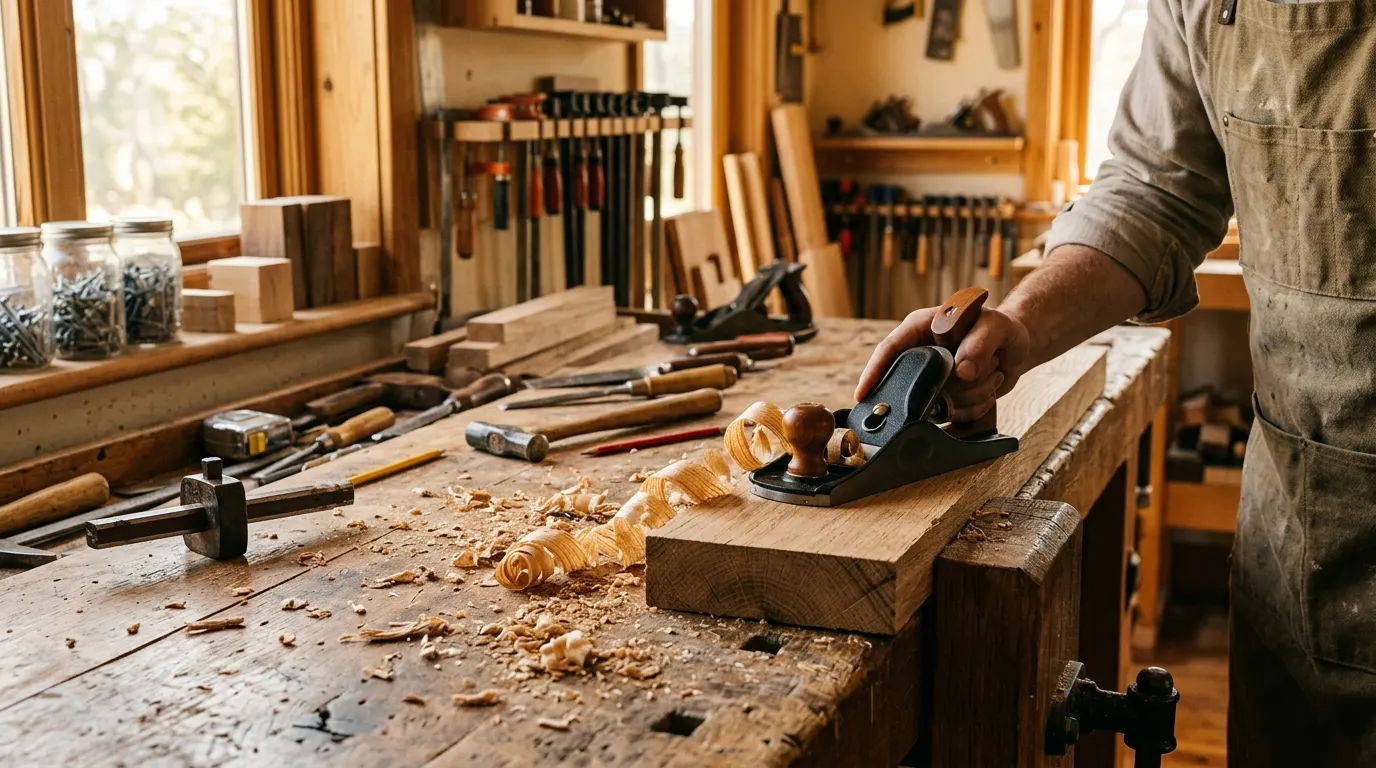
A block plane is small enough to hold and push with one hand, which is the entire point. Bench planes like a No. 4 or No. 5 are two-handed tools built to flatten and smooth long surfaces. A block plane is built for the small, frequent jobs that come up in the middle of other work: easing a sharp edge, trimming a tenon shoulder, knocking down a proud joint, or cleaning up end grain that tears out under a bench plane set for face-grain work.
The two things that separate a good block plane from a bad one are the bed angle and the mouth. The bed angle determines how the iron meets the wood and how well the plane handles end grain. The mouth is the gap in the sole in front of the iron, and how finely it adjusts determines whether the plane can take a whisper-thin finishing shaving or only a coarse one. A block plane that lacks an adjustable mouth is a much less versatile tool, since a fixed wide mouth guarantees tearout on figured or end-grain work no matter how sharp the iron is.
Most hand-tool woodworkers reach for a block plane constantly once they own a good one, which is why it tends to live in an apron pocket or sit permanently on the bench rather than in a tool chest.
Low angle versus standard angle: the bed angle that matters
A plane's effective cutting angle is the bed angle plus the iron's bevel angle. A standard-angle block plane has a 20-degree bed, so a 25-degree bevel gives an effective cutting angle around 45 degrees, close to a bench plane. That angle works fine with the grain but tends to tear end grain, where the fibers are being sheared across their length rather than sliced along it.
A low-angle block plane drops the bed to 12 degrees. With the same 25-degree bevel, the effective cutting angle comes down to around 37 degrees. That lower angle shears end-grain fibers instead of tearing them, which is the whole reason low-angle block planes exist and why they have become the default recommendation for a first block plane. The Veritas Low-Angle Block Plane uses this 12-degree bed for exactly this reason.
If you can only own one block plane, buy a low-angle one. It handles end grain noticeably better and still does every chamfer and edge-easing job a standard-angle plane does. A standard-angle block plane earns a place in a shop later, mainly for woodworkers who want a slightly higher, more durable cutting angle for repetitive work in hard or figured wood where a low-angle edge would need more frequent honing.
The Veritas Low-Angle Block Plane: the pick for most woodworkers
The Veritas Low-Angle Block Plane is the block plane the community keeps landing on, and the reasons are practical rather than aesthetic. The adjustable mouth opens wide for a heavy shaving on rough edge work and closes down to a hairline for a fine finishing pass on end grain, all with a knurled knob and no tools required. That range covers everything from knocking a chamfer on a table leg to trimming a dovetail pin flush without tearing the surrounding face grain.
The 12-degree bed and the option to fit a PM-V11 iron (sold separately) give this plane real headroom. PM-V11 holds an edge longer than the stock iron with a similar ease of sharpening, which matters on a tool that gets used dozens of times in a session. The precision machining on the body and sole means most of these arrive ready to use after a light honing, without the sole-lapping session a budget plane usually needs.
At $115 to $135, it costs more than a vintage flea-market find, but it removes the restoration step entirely. For a woodworker who wants one block plane that works well immediately and keeps working well for years, this is the one to buy.

Veritas Low-Angle Block Plane
A 12-degree bed angle with an adjustable mouth makes this block plane the most configurable small plane available at any price. The Veritas block plane shines on end-grain, small chamfers, and tight fitting work where a bench plane is too large. The PM-V11 iron option (sold separately) upgrades it further.
Vintage Stanley block planes: a legitimate budget path
Block planes are one of the best categories for buying vintage. Stanley made millions of them across the 20th century, and a No. 60 1/2 (low angle) or No. 9 1/2 (standard angle) in decent condition turns up at flea markets and estate sales for $15 to $40. Unlike a bench plane, a block plane has fewer parts to go wrong: no chip breaker to fit, no frog to seat, just a body, an iron, a lever cap, and a mouth adjustment.
The setup work is real but manageable. Flatten the sole on 120-grit sandpaper stuck to plate glass if the plane rocks on a straightedge. Check that the mouth adjustment screw still moves freely and that the adjustable throat plate is not worn or cracked, which is the most common failure point on a used block plane. Hone the iron from scratch, since a flea-market iron is almost never sharp and often has small nicks that need to be ground out before honing.
A vintage iron will need real time on a coarse stone or a Genuine Leather Bench Strop with Green Compound routine before it performs, since decades of use and improper sharpening leave most secondhand irons with an uneven bevel. Budget an hour of setup time for a $25 flea-market block plane, and it will perform close to a new production plane for a fraction of the price.

Genuine Leather Bench Strop with Green Compound
A smooth vegetable-tanned leather strop charged with green honing compound (chromium oxide) is the final step that makes an edge truly sharp and the maintenance tool that keeps it that way between full sharpenings. Five strops per session after the 4000-grit stone adds a polish that stones alone cannot match.
Setting up any block plane for clean end-grain cuts
A block plane iron gets honed the same way any plane iron does: flatten the back first, then establish a 25-degree primary bevel. The Shapton Glass Stone HR 1000 Grit and Shapton Glass Stone HR 4000 Grit give a fast, consistent progression that stays flat session after session, which matters on a small iron where an uneven stone quickly translates into an uneven edge. A budget alternative like the King Deluxe combo waterstone works fine too, provided you flatten it regularly.
A honing guide helps on a block plane iron more than it does on some bench plane irons, since the iron is short and easy to rock out of square by hand. The Veritas Mk.II Honing Guide registers the iron squarely and holds the angle consistent from session to session, which pays off directly in how evenly the mouth gap looks and how cleanly the plane cuts across its full width.
On the plane itself, back the mouth adjustment screw out until the mouth is fully open, take a test shaving, then close the mouth gradually until the shaving comes off in one clean, unbroken ribbon on end grain with no tearout. Waxing the sole with a block of paraffin lets the plane glide with less effort, which matters more on a block plane than a bench plane because most of the pushing happens with one hand. Skewing the plane slightly across the direction of travel on end grain also reduces the effective cutting angle further and helps a standard-angle plane perform closer to a low-angle one.

Shapton Glass Stone HR 1000 Grit
The benchmark for synthetic waterstone performance. Shapton Glass stones bond abrasive to a dimensionally stable glass backing that does not cup or warp. The 1000 grit cuts fast and leaves a scratch pattern that the next stone erases cleanly. The tool most serious hand-tool woodworkers reach for when they want a reliable, non-dishing sharpening surface.
Shapton Glass Stone HR 4000 Grit
The second stage in the Shapton Glass progression, taking the scratch pattern left by the 1000 grit and refining it to a near-mirror finish. The 4000 removes the 1000-grit scratches quickly and leaves an edge that shaves cleanly. Most woodworkers using Shapton Glass stones work 1000-4000-strop for routine sharpening.
Veritas Mk.II Honing Guide
The best production honing guide for consistent bevel angles. The Mk.II uses a camber roller for convex grinds, a standard roller for flat grinding, and a micro-adjust registration wheel to set the projection and therefore the bevel angle precisely. The skew-registration jig in the deluxe set handles skew blades and chisels up to 2.5 inches wide.
What a block plane cannot replace
A block plane is a companion tool, not a substitute for a smoothing plane. It is too small and too short to flatten a wide board or true a long edge, jobs that belong to a No. 4 like the Stanley Sweetheart No. 4 Smoothing Plane or a jointer plane. It also cannot level the bottom of a dado or housing joint to a consistent depth, which is what a dedicated tool like the Stanley No. 71 Router Plane (Vintage / Reissue) is built for.
Think of the buying order as layered rather than competitive: a smoothing plane for surfaces, a block plane for edges and end grain and small fitting work, and specialty planes like a router plane added later as specific joinery demands them. Buying a block plane does not delay the need for a bench plane, and buying a bench plane does not make a block plane optional. Most hand-tool woodworkers own both within their first few months.

Stanley Sweetheart No. 4 Smoothing Plane
Stanley's modern premium No. 4, made in England with a 0.100-inch thick iron and a body that is cast and finished to a higher standard than the standard Stanley line. The Sweetheart is not at Veritas or Lie-Nielsen level but it is a genuine working plane that many beginners use well for years before deciding they need more.
Stanley No. 71 Router Plane (Vintage / Reissue)
A router plane is the hand-tool answer to a plunge router for stopped dadoes, inlay recesses, and hinge mortises. The No. 71 rides the work surface on two wide feet and the iron cuts the bottom of a recess to a consistent depth. Vintage Stanleys are abundant and cheap at flea markets; the Veritas version is the modern reissue with better adjustability.
What to skip
Avoid unbranded budget block planes sold as generic imports with no adjustable mouth, a soft cast body that will not hold flat, and an iron that will not take or hold an edge no matter how well you sharpen it. These show up cheap on marketplaces and in big-box tool aisles, and they teach a beginner that block planes do not work well, when the real problem is the specific tool. A fixed-mouth plane in particular guarantees tearout on end grain regardless of how sharp the iron is.
Also skip buying a second block plane before you have mastered sharpening and mouth adjustment on your first one. A single well-tuned low-angle block plane covers nearly everything a hand-tool shop needs. A dedicated standard-angle plane, a shoulder plane, or a low-angle smoother are all real upgrades eventually, but none of them should come before the basic low-angle block plane is set up and used until it feels automatic.
Featured in this guide
Veritas Low-Angle Block Plane
A 12-degree bed angle with an adjustable mouth makes this block plane the most configurable small plane available at any price. The Veritas block plane shines on end-grain, small chamfers, and tight fitting work where a bench plane is too large. The PM-V11 iron option (sold separately) upgrades it further.
Genuine Leather Bench Strop with Green Compound
A smooth vegetable-tanned leather strop charged with green honing compound (chromium oxide) is the final step that makes an edge truly sharp and the maintenance tool that keeps it that way between full sharpenings. Five strops per session after the 4000-grit stone adds a polish that stones alone cannot match.
Shapton Glass Stone HR 1000 Grit
The benchmark for synthetic waterstone performance. Shapton Glass stones bond abrasive to a dimensionally stable glass backing that does not cup or warp. The 1000 grit cuts fast and leaves a scratch pattern that the next stone erases cleanly. The tool most serious hand-tool woodworkers reach for when they want a reliable, non-dishing sharpening surface.
Veritas Mk.II Honing Guide
The best production honing guide for consistent bevel angles. The Mk.II uses a camber roller for convex grinds, a standard roller for flat grinding, and a micro-adjust registration wheel to set the projection and therefore the bevel angle precisely. The skew-registration jig in the deluxe set handles skew blades and chisels up to 2.5 inches wide.
Stanley Sweetheart No. 4 Smoothing Plane
Stanley's modern premium No. 4, made in England with a 0.100-inch thick iron and a body that is cast and finished to a higher standard than the standard Stanley line. The Sweetheart is not at Veritas or Lie-Nielsen level but it is a genuine working plane that many beginners use well for years before deciding they need more.
Keep reading
Related comparisons
Related roundups
FAQ
Frequently asked questions
What is the difference between a low-angle and a standard-angle block plane?+
The bed angle. A low-angle block plane has a 12-degree bed, which combined with a 25-degree bevel gives an effective cutting angle around 37 degrees, ideal for shearing end grain cleanly. A standard-angle block plane has a 20-degree bed and an effective cutting angle around 45 degrees, closer to a bench plane and slightly more durable in hard or figured wood, but more prone to tearing end grain. Most woodworkers buy low-angle first.
Do I need a block plane if I already own a smoothing plane?+
Yes. A smoothing plane and a block plane solve different problems. A No. 4 flattens and smooths broad surfaces two-handed. A block plane handles the one-handed jobs that come up constantly: easing an edge, trimming end grain, flushing a proud joint, and fitting parts during assembly. Most hand-tool woodworkers reach for a block plane more often, in raw frequency of use, than any other single plane in the shop.
Can a vintage Stanley block plane compete with a new Veritas?+
Yes, after setup. A vintage Stanley No. 60 1/2 or No. 9 1/2 in decent condition, with a flattened sole, a freely moving mouth adjustment, and a properly honed iron, performs very close to a new production plane. The Veritas costs more but skips the setup time and the risk of buying a plane with a worn or cracked throat plate. Both are legitimate paths depending on how much setup time you want to spend.
What bevel angle should I hone a block plane iron to?+
A 25-degree primary bevel is the standard starting point for both low-angle and standard-angle block planes. Some woodworkers add a 30-degree micro-bevel on a low-angle plane for extra durability in hard or abrasive wood, since the low bed angle already gives a shallow effective cutting angle and a slightly steeper micro-bevel adds edge strength without giving up the end-grain performance the low bed angle provides.
Why does my block plane tear out end grain even though the iron is sharp?+
The most common cause is a mouth opening that is too wide for the shaving thickness being taken. Close the mouth adjustment until the gap just clears the shaving. The second most common cause is a bevel angle that is too high for the wood, which is why a low-angle plane is the better choice for end-grain-heavy work. A dull or nicked edge is the third cause and the easiest to rule out by re-honing.