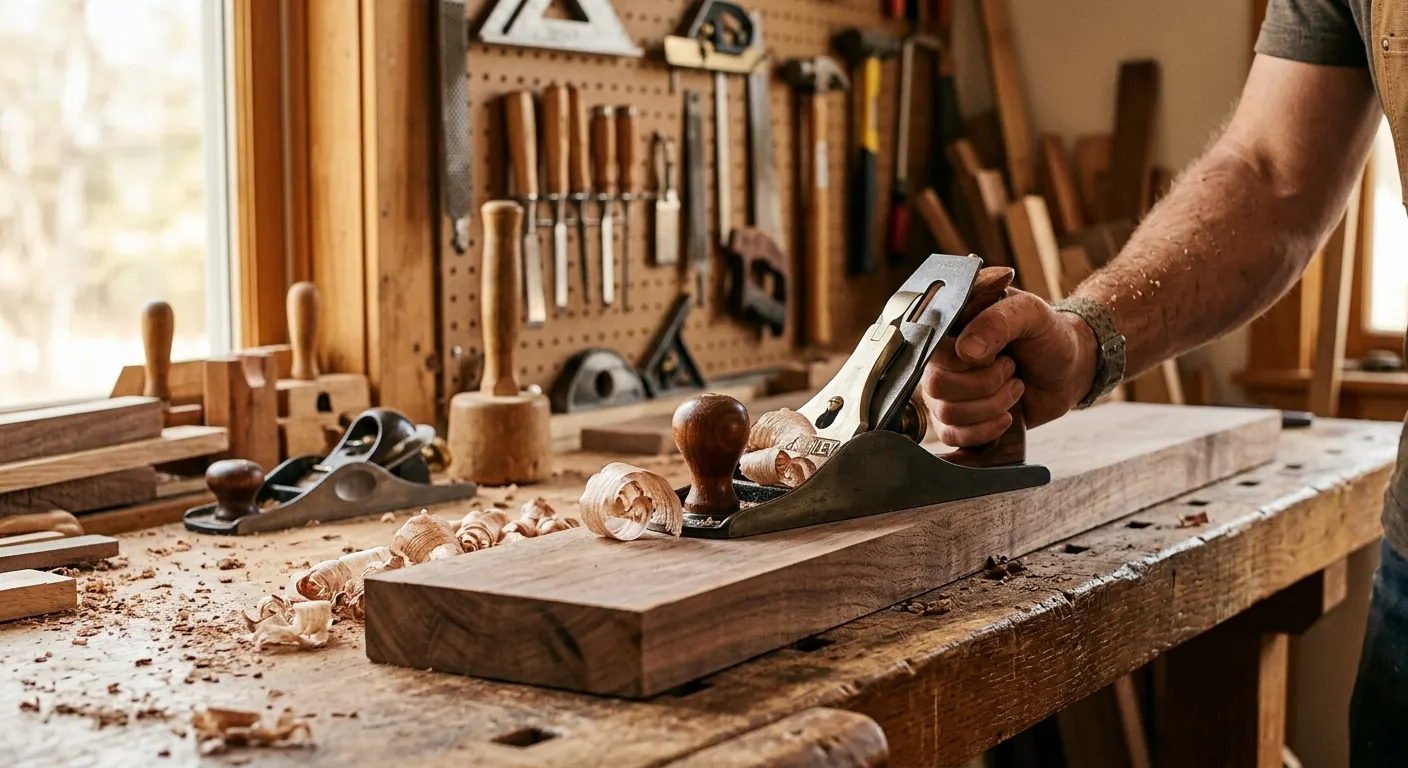
Best Hand Planes for Beginners
By BenchTrue . 12 min read . Updated June 2026
The hand plane is the tool that defines the hand-tool woodworking experience. A sharp smoothing plane on hardwood produces a surface that no sandpaper can replicate: the wood fibers are cut, not abraded, and the result has a clarity and sheen that reveals the grain completely. Getting there requires knowing which plane to buy first, which brand and price point makes sense at your stage, and how the different plane numbers relate to different jobs. The community debates Veritas versus Lie-Nielsen endlessly and for good reason, but there is also a clear beginner path that leads from a Stanley Sweetheart through a WoodRiver jack plane and eventually to the premium tier. This guide covers that path honestly.
Quick answer
The best hand plane for most beginners is the Stanley Sweetheart No. 4: affordable, made in England with genuine quality, and the right tool to learn setup and use before committing to premium spending. Once you have the technique, the Veritas Custom Bench Plane No. 4 is the best-engineered production smoother available and the one serious woodworkers buy once.
This guide contains affiliate links. BenchTrue may earn a commission at no cost to you.
Why the No. 4 smoothing plane is the right first purchase
The hand-plane number system describes the size: No. 1 through No. 8, from tiny to massive. The No. 4 smoothing plane sits at the versatile middle: heavy enough to hold registration on a board without chatter, light enough to control precisely, and the right size for smoothing, edge-trimming, and light dimensioning. Nearly every authority in the hand-tool woodworking community - Paul Sellers, Rob Cosman, Rex Krueger - recommends a No. 4 as the first plane.
A No. 5 jack plane is the workhorse for heavy stock removal. A No. 7 or No. 8 jointer plane is for flattening long panels and edge-jointing boards. A block plane handles end grain and one-handed work. You will want all of them eventually. Start with the No. 4. It teaches you how a hand plane works - how to set the mouth, tune the chip breaker, lap the iron - and produces work you can be proud of from the beginning.
Entry point: the Stanley Sweetheart No. 4
The Stanley Sweetheart No. 4 Smoothing Plane is the honest beginner choice. Made in England (not the standard Stanley line of variable quality), the Sweetheart uses a 0.100-inch thick iron with a body cast and machined to tighter tolerances than budget bench planes. It is not a Veritas or a Lie-Nielsen, but it is a real hand plane that produces real results after an hour of setup work.
The setup process for a Sweetheart is part of the learning. Flatten the sole on 120-grit sandpaper taped to plate glass - check with a reliable straightedge first, because many examples need only light lapping at the toe and heel. Flatten the back of the iron on your waterstone from coarse through 4000 grit, then hone the bevel at 25 to 30 degrees. Fit the chip breaker so it seats against the iron with no gap. That two-hour process teaches you what a hand plane is and how its parts work together, which makes you a better planer before you make a single shaving.
The Sweetheart thinner iron does vibrate more in hard, figured wood than the thick irons in premium planes. It is not a disqualifying flaw - a sharp, well-set Sweetheart handles most woods well - but it is the limitation that eventually sends woodworkers toward the premium tier.

Stanley Sweetheart No. 4 Smoothing Plane
Stanley's modern premium No. 4, made in England with a 0.100-inch thick iron and a body that is cast and finished to a higher standard than the standard Stanley line. The Sweetheart is not at Veritas or Lie-Nielsen level but it is a genuine working plane that many beginners use well for years before deciding they need more.
Upgrade path: WoodRiver No. 5 jack plane
The WoodRiver No. 5 Jack Plane is a compelling second plane for two reasons. First, a No. 5 jack plane is the workhorse of the hand-tool shop: it does the heavy stock removal, rough dimensioning, and surface flattening that burns through an edge on a smoothing plane fast. Doing heavy work on the jack plane and finishing work on the smoother extends sharpening intervals significantly.
Second, the WoodRiver is a better-made tool than the Stanley Sweetheart. Woodcraft specifications include a heavier casting, an A2 steel iron, and better tolerances than the standard Stanley line. At mid-range pricing it punches above its weight. The sole still needs lapping on most examples - budget 30 minutes with sandpaper and a flat surface - but the result is a jack plane that handles demanding work reliably.
The combination of a Stanley Sweetheart No. 4 and a WoodRiver No. 5 covers everything from rough dimensioning to fine surface work for under $300. That is a practical two-plane shop that most hand-tool woodworkers would recognize as genuinely capable.

WoodRiver No. 5 Jack Plane
Woodcraft's house-brand jack plane, made to a specification that significantly exceeds the standard Stanley line. The No. 5 jack plane is the workhorse of the hand-tool shop: it dimensions rough stock, flattens wide panels, and does the heavy stock-removal work before the smoothing plane takes over. WoodRiver planes are well regarded for their price-to-performance ratio.
Premium tier: Veritas versus Lie-Nielsen
At some point a woodworker who uses hand planes regularly wants to stop thinking about setup and simply use the tool. The Veritas Custom Bench Plane No. 4 (Smoothing Plane) and Lie-Nielsen No. 4 Smoothing Plane (A2 Steel) are where that conversation starts.
The Veritas Custom Bench Plane No. 4 (Smoothing Plane) uses a PM-V11 steel iron 0.156 inches thick, a Norris-style adjuster for precise control without backlash, and a ductile iron body machined to tight tolerances that need minimal lapping. The PM-V11 steel is the engineering story: it holds an edge longer than A2 with similar ease of sharpening and is Veritas's best iron material. The community considers it the best-engineered production plane available.
The Lie-Nielsen No. 4 Smoothing Plane (A2 Steel) uses A2 steel and ductile iron with bronze hardware details and a fit and finish that is genuinely exceptional. The Lie-Nielsen has the aesthetic argument: it is beautiful in a way that matters to people who spend hours with tools in their hands. In use, Veritas and Lie-Nielsen are peer tools. The community debates them as equals. Buy the one whose design you respond to - you will use it for the rest of your woodworking life.
Both are significant investments. Neither makes sense as a first plane purchase unless budget is not the constraint. The right path for most woodworkers is Stanley Sweetheart to learn, WoodRiver jack to add capability, and Veritas or Lie-Nielsen when the work demands a tool that gets out of the way.
Veritas Custom Bench Plane No. 4 (Smoothing Plane)
The most highly engineered production smoothing plane available. Veritas Custom planes use a 0.156-inch-thick PM-V11 iron, a Norris-style adjuster for precise depth and lateral control, and a ductile iron body machined to tight tolerances. The PM-V11 steel holds an edge longer than A2 with similar sharpening ease. The community considers Veritas and Lie-Nielsen peer tools at slightly different price points.
Lie-Nielsen No. 4 Smoothing Plane (A2 Steel)
The American-made benchmark smoothing plane, ground from ductile iron with an A2 steel iron ground to a precise 25-degree primary bevel. Lie-Nielsen planes arrive ready to tune and have been the gold standard for production hand planes in the American hand-tool community for decades. The feel and finish are exceptional.
Block plane: the second tool most woodworkers buy
A block plane is not a smoothing plane used on its side. It is a small, low-angle plane designed for end grain, chamfers, small fitting work, and any application where one-handed control and precision matter more than covering a large surface. You will reach for a block plane on almost every project.
The Veritas Low-Angle Block Plane is the best production block plane available. The 12-degree bed angle with an adjustable mouth makes it configurable for both heavy shavings and fine finish cuts. The precision machining throughout means the mouth adjustment is consistent and the sole is flat from the factory. A block plane this capable rewards the investment because it gets used constantly.
If a block plane is your second purchase and budget is a consideration, a quality vintage Stanley No. 60-1/2 found secondhand is an excellent alternative. Set it up with a sharp iron, flatten the sole if needed, and it works well. The Veritas is the upgrade path when you want adjustability and precision without vintage tool gambles.
Veritas Low-Angle Block Plane
A 12-degree bed angle with an adjustable mouth makes this block plane the most configurable small plane available at any price. The Veritas block plane shines on end-grain, small chamfers, and tight fitting work where a bench plane is too large. The PM-V11 iron option (sold separately) upgrades it further.
Router plane: the specialist that earns its place
Once you move into furniture joinery - dadoes, housings, hinge mortises, inlay work - a router plane becomes the tool you reach for to clean and level the floor of a recess to a consistent depth. No power router gives the control that a hand router plane does in stopped work.
The Stanley No. 71 Router Plane (Vintage / Reissue) is the vintage Stanley workhorse for this job. Vintage examples are abundant and inexpensive at flea markets; the challenge is that they need blade sharpening and general cleanup before use. The Veritas router plane is the modern alternative with better adjustability. Either way, a router plane is not a first purchase - it earns its place in the kit when a project actually requires it.
If you restore or buy vintage, a good flea-market No. 71 after sharpening the iron with a quality aftermarket iron works beautifully. If you want to buy new and tune nothing, the Veritas version is the straightforward choice.
Stanley No. 71 Router Plane (Vintage / Reissue)
A router plane is the hand-tool answer to a plunge router for stopped dadoes, inlay recesses, and hinge mortises. The No. 71 rides the work surface on two wide feet and the iron cuts the bottom of a recess to a consistent depth. Vintage Stanleys are abundant and cheap at flea markets; the Veritas version is the modern reissue with better adjustability.
Upgrading a vintage Stanley: the Hock iron path
One popular path in the community bypasses new planes entirely: buy a vintage Stanley No. 4 in good condition from a flea market for $20 to $60, fit it with a Hock Tools O1 Replacement Plane Iron , and you have a tool that performs close to premium production planes at a fraction of the cost.
The Hock O1 replacement iron is 0.125 inches thick, substantially heavier than the original thin Stanley iron, and takes a finer edge. Fitting it involves adjusting the chip breaker so it seats properly on the thicker blank - usually 20 to 30 minutes of careful fitting. The result is a vintage plane with modern iron performance. Many woodworkers in the r/handtools community use exactly this setup as their daily smoother.
This path works best for woodworkers who are comfortable with the setup process and enjoy the restoration aspect. If you want something that works out of the box with minimal fuss, the Stanley Sweetheart No. 4 Smoothing Plane or the premium tier is the more reliable choice.
Hock Tools O1 Replacement Plane Iron
Hock Tools make the go-to replacement iron for vintage Stanley planes. The O1 tool steel is thicker than original Stanley blades (0.125 inches), harder, and takes a finer edge. Fitting a Hock iron to a vintage No. 4 is the most cost-effective way to get near-Lie-Nielsen performance from a $30 flea-market plane.
Stanley Sweetheart No. 4 Smoothing Plane
Stanley's modern premium No. 4, made in England with a 0.100-inch thick iron and a body that is cast and finished to a higher standard than the standard Stanley line. The Sweetheart is not at Veritas or Lie-Nielsen level but it is a genuine working plane that many beginners use well for years before deciding they need more.
Featured in this guide
Stanley Sweetheart No. 4 Smoothing Plane
Stanley's modern premium No. 4, made in England with a 0.100-inch thick iron and a body that is cast and finished to a higher standard than the standard Stanley line. The Sweetheart is not at Veritas or Lie-Nielsen level but it is a genuine working plane that many beginners use well for years before deciding they need more.
Veritas Custom Bench Plane No. 4 (Smoothing Plane)
The most highly engineered production smoothing plane available. Veritas Custom planes use a 0.156-inch-thick PM-V11 iron, a Norris-style adjuster for precise depth and lateral control, and a ductile iron body machined to tight tolerances. The PM-V11 steel holds an edge longer than A2 with similar sharpening ease. The community considers Veritas and Lie-Nielsen peer tools at slightly different price points.
WoodRiver No. 5 Jack Plane
Woodcraft's house-brand jack plane, made to a specification that significantly exceeds the standard Stanley line. The No. 5 jack plane is the workhorse of the hand-tool shop: it dimensions rough stock, flattens wide panels, and does the heavy stock-removal work before the smoothing plane takes over. WoodRiver planes are well regarded for their price-to-performance ratio.
Veritas Low-Angle Block Plane
A 12-degree bed angle with an adjustable mouth makes this block plane the most configurable small plane available at any price. The Veritas block plane shines on end-grain, small chamfers, and tight fitting work where a bench plane is too large. The PM-V11 iron option (sold separately) upgrades it further.
Hock Tools O1 Replacement Plane Iron
Hock Tools make the go-to replacement iron for vintage Stanley planes. The O1 tool steel is thicker than original Stanley blades (0.125 inches), harder, and takes a finer edge. Fitting a Hock iron to a vintage No. 4 is the most cost-effective way to get near-Lie-Nielsen performance from a $30 flea-market plane.
Keep reading
Related comparisons
Related roundups
FAQ
Frequently asked questions
Should I buy a No. 4 smoothing plane or a No. 5 jack plane first?+
Buy the No. 4 smoothing plane first. A No. 4 is more versatile for learning: it smooths surfaces, trims edges, and does light dimensioning. A No. 5 jack plane is the better workhorse for heavy stock removal and rough dimensioning, but it is the second plane, not the first. Once you understand how a hand plane works and tunes, the No. 5 is the most valuable addition to the kit.
Is a Lie-Nielsen or Veritas hand plane worth the price for a beginner?+
Not as a first purchase unless budget is not a concern. Both are exceptional planes that reward woodworkers who have already learned how a hand plane works and tunes. A beginner who buys a Veritas or Lie-Nielsen before understanding chip breakers, mouth width, and iron geometry does not get full value from the tool. Learn on a Stanley Sweetheart, then invest in the premium tier when the tool is holding you back rather than the technique.
Do I need to lap the sole of a new hand plane?+
Check before assuming. Premium planes like Veritas and Lie-Nielsen arrive flat to a high tolerance and rarely need lapping. Mid-range planes like the Stanley Sweetheart and WoodRiver often have high spots at the toe and heel that benefit from light lapping. Use a reliable straightedge under strong light to check the sole before starting. If it is flat, use the plane. If it rocks, lap it on sandpaper on plate glass until it registers flat end to end.
What is a chip breaker and why does it matter?+
The chip breaker is the second piece of iron clamped against the back of the plane iron, set back from the cutting edge by a small distance. Its job is to curl the shaving upward before it can run ahead of the iron and cause tearout in the wood. The closer the chip breaker is set to the edge (0.5 to 1mm for smoothing), the more it controls tearout on figured or reversing grain. The chip breaker must seat flat against the iron with no gap, or shavings pack under it and the plane clogs.
Can I use a hand plane on softwood as well as hardwood?+
Yes, but the technique adjusts. Softwood is more susceptible to tearout and compression, so a finer mouth (narrow gap in front of the iron) and a sharp edge are essential. A plane that performs adequately on softwood with a slightly open mouth may tear badly on pine with figured grain. Close the mouth and take finer shavings. Hardwood like cherry and walnut is actually more forgiving for smoothing with a hand plane than some softwoods.
How long does setting up a hand plane take for the first time?+
Expect 60 to 90 minutes for a new Stanley Sweetheart or WoodRiver: flatten the back of the iron on the 1000-grit stone (20 to 30 minutes the first time), hone the bevel at 25 to 30 degrees with a honing guide (15 minutes), check and lap the sole if needed (15 to 30 minutes), set the chip breaker, and adjust the mouth. A Veritas or Lie-Nielsen typically needs only iron honing and basic adjustments - maybe 30 minutes. After the initial setup, routine sharpening and adjustment takes 5 to 10 minutes.